
Routine activity theory (RAT) was developed by Lawrence E. Cohen and Marcus Felson in 1979 as a way to explain the increasing crime rates in the United States after WWII. This criminological theory differs from most theories because it focusses on the criminal event rather than the criminal or psychological causations that motivate criminal activity. Routine activity theory (RAT) has its foundation in human ecology and rational choice theory.
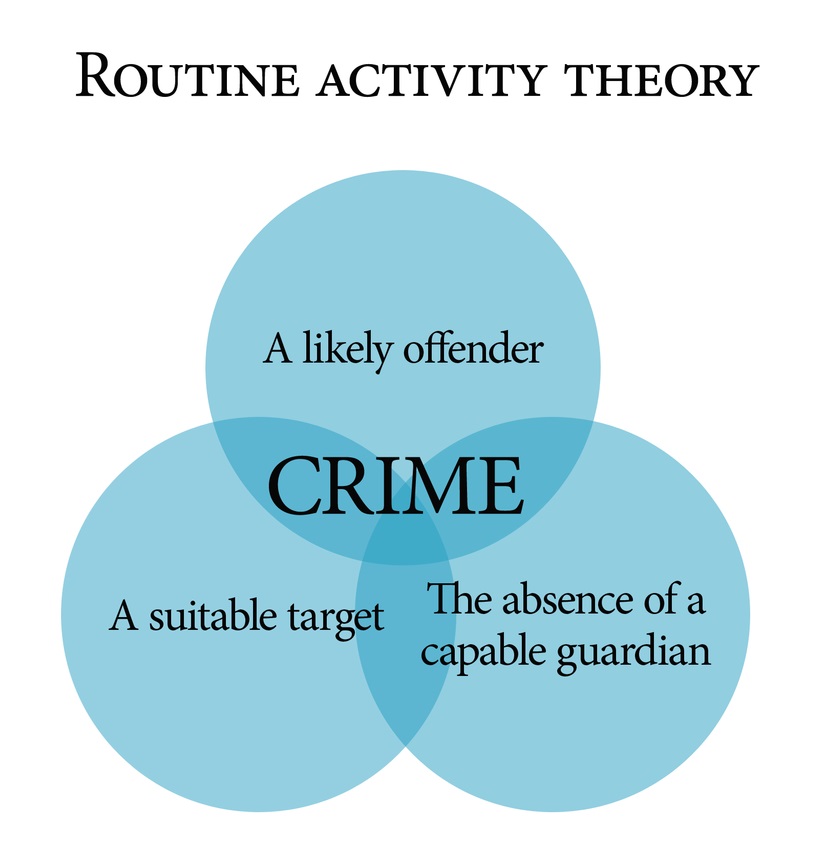
Routine activity theory (RAT) explains crime as the result of three elements converging in time and space:
- A motivated offender
- A suitable target
- The absence of a capable guardian
Cohen and Felson argued that all three must come together in order for criminal activity to be realized.
Critics of RAT focus on the lack of understanding what is motivating offenders; however, Cohen and Felson choose to ignore the underlining psychological aspects of personal motivation of a criminal and focus on the fact the offender is simply motivated to participate in criminal activity.
Routine activities theory can be used to teach people how not to become crime victims. For example, would-be-victims may choose whether to become victims or not via their choices by avoiding dangerous situations, and thereby, decrease their likelihood of becoming victims.
Today routine activity theory has gained popularity within the crime sciences because it has been used to explain how daily changes in a person’s routine can lead to changes in crime rates. For example, during the day most people are at work and their homes are empty, and this offers an opportunity for more burglaries to occur. RAT research has also led community leaders to look at protecting public spaces by adding surveillance cameras, community watch programs, and other protective technology to increase community safety.
Most recently, routine activity theory has been used to analyze cybercrime given the three elements that make up the foundation of RAT are often discovered with cybercrimes.
________________________________________________
About the Author
Mark Bond has worked in law enforcement and has been a firearms instructor for more than 33 years. His law enforcement experience includes the military, local, state, and federal levels as a police officer and criminal investigator. Mark obtained a BS and MS in criminal justice, and M.Ed in educational leadership with Summa Cum Laude honors. Mark has a doctoral degree in education (EdD) with a concentration in college teaching and learning. Mark is currently an associate professor of human justice studies and teaches undergraduate and graduate criminal justice courses.
 e-Roll Call Magazine